dev
AI Fads Die Quicker Than They’re Born
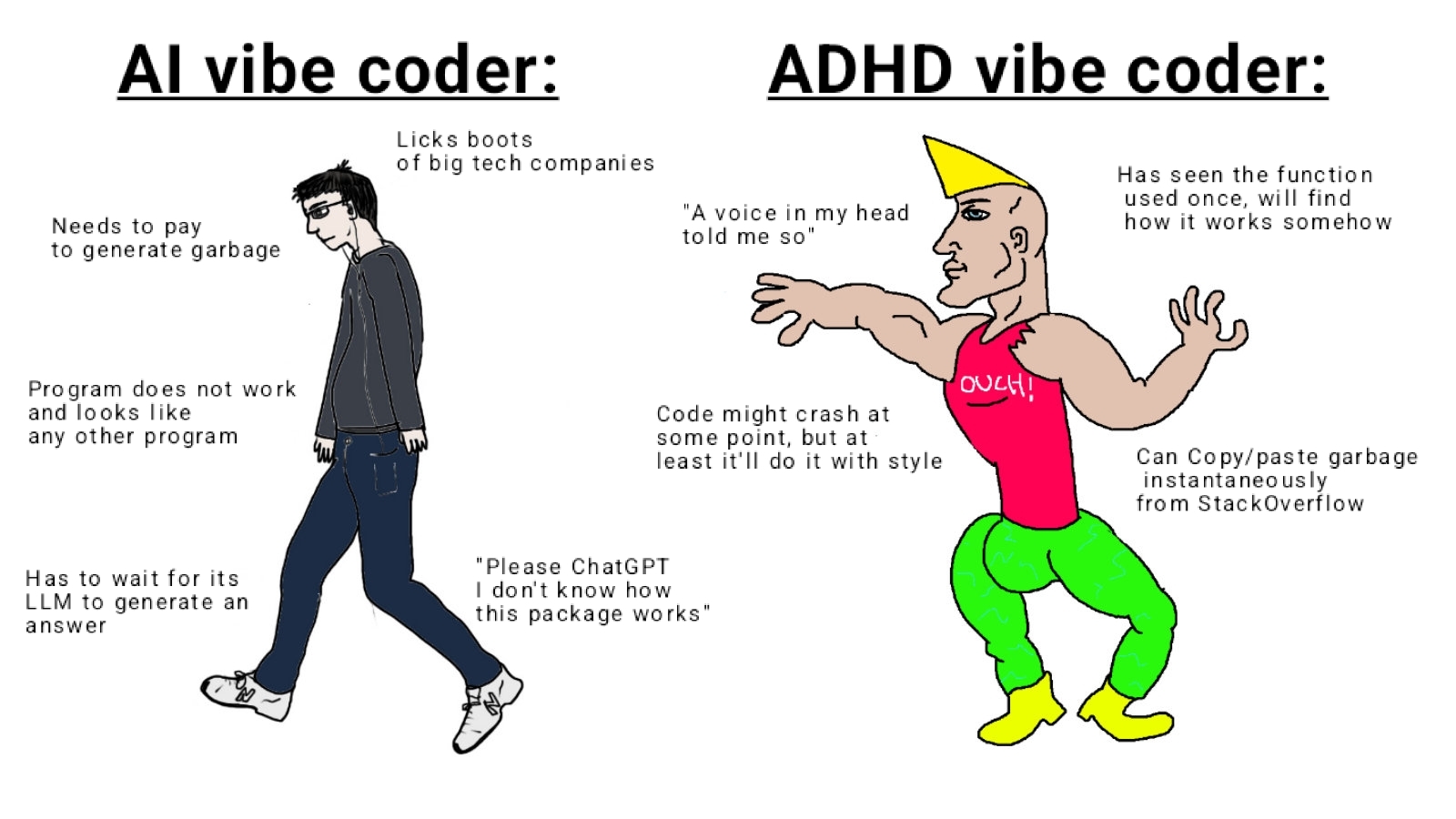
AI vs ADHD meme from programmerhumor
The more I live, the more I notice how often people will do everything possible to avoid moving a single brain cell. It’s not because we’re lazy by design—it’s because the human brain is literally wired to seek the easiest solution, even when the problem itself is complex. And in tech, that instinct has shaped entire movements, from no-code platforms to the current AI-first era.
No-Code Dreams
A decade ago, no-code platforms like Webflow and Framer exploded. They promised the dream: “Anyone can be a developer without writing a single line of code.” And for a moment, it worked. Designers, marketers, and entrepreneurs all jumped in, convinced they could ship production-ready apps and websites instantly.
But then reality hit. These platforms required at least a basic grasp of logic, structure, and systems thinking. Even if you didn’t touch raw code, you still needed to understand concepts like responsiveness, databases, and user flows. As one TechCrunch article highlighted, most no-code users eventually learned some code anyway just to get around limitations.
Full Automation With AI
Fast-forward to today, and we’re living in the era of AI-native dev tools. Platforms like V0 by Vercel and Lovable take no-code to the next level—removing even the minimal friction that Webflow once had. Now, you don’t drag and drop components. You just describe your idea in plain English, and the machine builds it for you. From resolving art block to generating UI/UX, to even handling system design—it’s all automated.
It feels magical. And it works. AI can indeed generate functional products faster than most junior dev teams.
Creativity and Human Touch
But here’s the catch: products built by machines often lack soul. You rarely feel the emotion, the story, or the human struggle behind them. And that matters more than people think.
Take Apple, for instance. Their success wasn’t built on “just functional” products—it was built on products infused with story, design philosophy, and emotional connection. AI can mimic these elements, but it struggles to originate them. MIT Technology Review has already pointed out that while generative AI excels at remixing patterns, it still fails at authentic originality.
Similarly, in design, there’s a reason handmade art or indie games like Undertale connect with people on a level AAA studios struggle to replicate. It’s the imperfections, the quirks, the humanity. An AI can produce a landing page, but it won’t give you the kind of story that fuels brand loyalty or cultural impact.
Where AI Will Fail
I believe these AI platforms will eventually hit a wall—not because they don’t work, but because they work too well. If everyone uses the same AI to generate their startup ideas, designs, or code, the internet will fill with functional but soulless products. Differentiation will disappear.
A Harvard Business Review piece warned of this exact issue: when everyone has access to the same automated tools, creativity becomes the real bottleneck. The advantage shifts back to human originality—the story you tell, the emotion you weave into your product, the sense of purpose that no machine can fake.
The Future Is Hybrid
AI is a tool, not a replacement. It’s incredible for getting from zero to one—bootstrapping an MVP, brainstorming variations, or automating the boring stuff. But the products that win will always be the ones with a human imprint. A story. A feeling. An intention that cuts deeper than automation.
As developers, designers, and creators, our job isn’t just to ship functional products anymore. It’s to remind people that behind every screen, there’s a human who cared enough to shape the experience. And that, I believe, will always be beyond AI comprehension.